How we cut support backlog by 61% with three small agents
 Maya Okafor
8 min read

Six months ago our support queue at Brightloom was a slow-motion emergency: 3,400 open tickets, a median first response of 19 hours and a team that was burning out answering the same twenty questions. Here's exactly how we turned it around — without a big-bang “AI transformation”.
Why small agents win
Our first instinct was to build one super-agent that could handle any ticket. It was impressive in demos and impossible to trust. Every failure was a mystery, and every fix broke something else.
So we started over with a simple rule: one agent, one job, one owner. Each agent would be small enough to evaluate exhaustively and boring enough to explain to a new hire.
“The moment we split the super-agent into three boring ones, our accuracy jumped and — more importantly — we could finally explain every mistake.”— Maya Okafor, Head of Support
Agent 1: Triage
The triage agent reads every incoming ticket, classifies intent, detects language and urgency, and routes it. It never replies to customers. That single constraint let us ship it in a week.
- 14 intents, each with a golden set of 50 real tickets
- Confidence below 0.85 goes to a human queue
- Accuracy after two weeks: 97.2%
Agent 2: Drafting
The drafting agent writes replies grounded in our help center and policies — and cites the sources it used. For the first month, every draft went to a human for approval. We tracked one metric obsessively: the percentage of drafts sent without edits.
Agent 3: Refunds
Refunds were the scariest part, so we built this agent last and gave it the tightest rules. It can only refund duplicate charges, only up to $100, and only when the invoice match is exact.
const refunds = synthra.agent("refund-handler", {
  tools: [billing.refund],
  approve: ({ amount }) => amount > 100,
  guardrails: ["exact-invoice-match", "one-refund-per-customer-per-30d"],
});The guardrails that mattered
Out of the 30-odd rules we wrote, three did almost all of the work:
- Exact-match requirements for anything involving money.
- Topic boundaries so agents decline anything outside their job.
- Escalation with context — every hand-off includes a summary, the sources and the agent's best guess.
Results & lessons
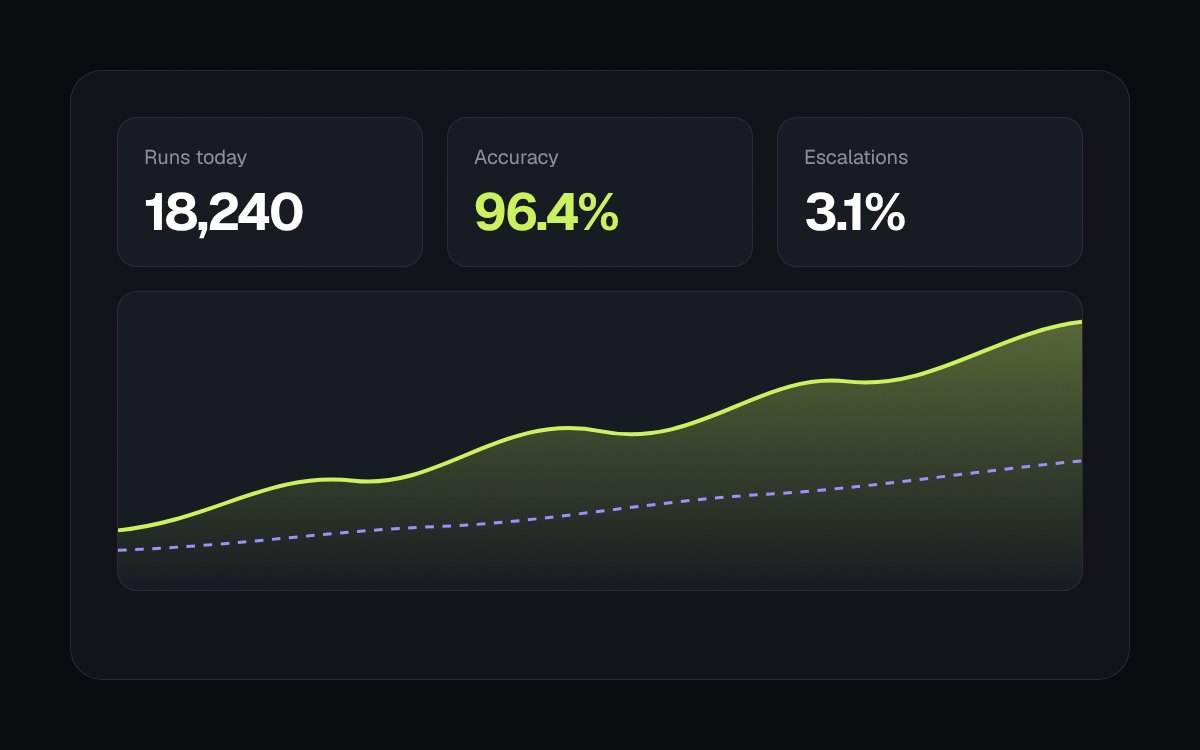
After 90 days, 61% of tier-one tickets were resolved end-to-end by agents, median first response dropped to 1 minute 48 seconds, and CSAT rose nine points. The team now spends its time on the complex conversations that actually need a human.
If you're starting out, start small. Pick the most repetitive job you have, build the most boring agent you can, and measure it relentlessly. Then do it again.
Maya leads a 40-person support org and writes about building calm, scalable customer operations.